



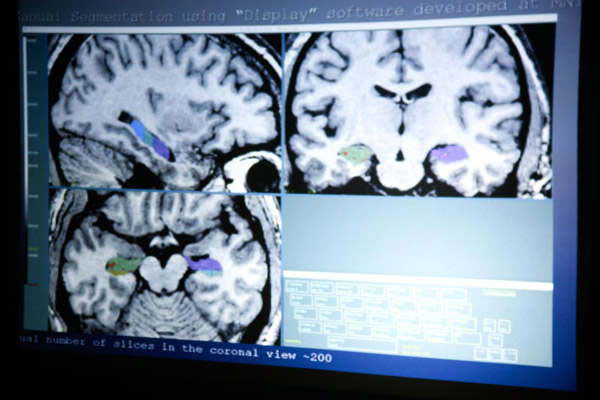
The lab uses brain imaging to examine the neural substrates of learning and memory in healthy young adults. It also aims to understand how normal aging and various forms of dementia affect these substrates and mnemonic abilities.
Research Projects
Structural and functional neuro-anatomical correlates of memory for context across the adult life span
Funding: CIHR Institute of aging
Period: 2012-2018
Our ability to remember our past, personal, experiences in rich contextual detail declines with age and can be an early sign of Alzheimer’s disease (AD). We know that this decline in memory function starts before the age of 60yrs, however we do not know: 1) when these deficits first emerge in adulthood, 2) what initial brain changes are linked to the onset of these deficits, 3) which of these changes are associated with AD risk, and 4) whether there are neural resources available to protect against this memory decline with age.
The proposed research program will use a cutting edge brain imaging technique called event-related functional magnetic resonance imaging (fMRI) to measure brain activity and brain volume across the adult lifespan. Specifically we will test an equal sample of healthy young, middle aged and older adults with, and without, a family history of late-onset sporadic AD, a known risk factor for future development of AD. These individuals will perform memory tasks while undergoing fMRI scanning. By studying memory function across the adult lifespan in persons with and without family history of AD, we will be able to determine when memory deficits emerge in adulthood, what brain changes are associated with this emergence and whether having a risk factor for AD alters the time of onset or pattern of brain changes associated with memory function. This information will provide us with possible neural targets for the design and tracking of future programs aimed and preventing memory decline and AD in our society.
Dissociating regional changes in prefrontal cortex structure and function that impact memory performance with normal aging
Funding: Fond de la Recherche en Santé du Québec (FRSQ) and CIHR Institute of Aging
Period: 2006-2011
It is hypothesized that age-related deficits in different types of memory are due to age-related changes in prefrontal cortex (PFC) function. Functional neuroimaging studies have suggested that the human PFC is not functionally homogeneous, and that with age there may be regional differences in PFC decline. Therefore, to understand how age-related deficits in memory relate to deficits in PFC function, one must examine region-specific changes in PFC structure and function that correlate with performance deficits on memory tasks.
The objective of the project is to identify region-specific, age-related changes in PFC structure and function that cause memory deficits. Results from this study will lead to the development of targeted neuro-cognitive rehabilitation methods for treating early signs of memory deficits in older adults prior to the onset of dementia.
Investigating prefrontal contributions to source and temporal order memory for faces and words
Funding: Natural Sciences and Engineering Research Council (NSERC)
Period: 2006-20011
The prefrontal cortex (PFC) comprises most of the human frontal lobes and is known to be important for mediating higher cognitive functions that differentiate human beings from other primates. One such higher cognitive function is the ability to encode and recollect highly detailed accounts of our past personal experiences: this is referred to as episodic memory (EM). Neuroimaging studies have identified regional differences in PFC involvement during the retrieval of different types of memory. However, debate continues over which cognitive processes these distinct PFC regions facilitate, and whether these processes are EM-specific in nature or are related to more general cognitive control, or "executive" processes, such as monitoring, response selection and strategic organization.
The objective of the project is to investigate the region-specific contributions of PFC to EM retrieval. Event-related fMRI will allow the lab to examine regional PFC activity as healthy adult volunteers perform different memory tasks for faces. Results from this research will help determine whether there are subregions of the PFC that are differentially related to the aforementioned executive processes, consistently, across episodic memory tasks and across various levels of task difficulty.
Structural equation modeling and functional connectivity analyses of prefrontal and medial temporal cortex interaction during episodic learning and memory for visual stimuli
Funding: Natural Sciences and Engineering Research Council (NSERC)
Period: 2006-2011
Multivariate statistical techniques allow one to examine the patterns of task and behaviour-related whole-brain activity and interactivity, respectively. This affords identification of large-scale neural networks engaged while subjects perform various experimental tasks. This project will employ structural equation modeling, spatio-temporal partial least squares analysis and simple functional connectivity analyses to identify the neural networks engaged during episodic encoding and retrieval for item versus context memory tasks.
The objective of the project is to determine, using event-related fMRI measures and multivariate statistical analyses, trial-by-trial differences in the pattern of interactions between prefrontal and medial temporal cortices, when subjects correctly vs. incorrectly recollect item, source and temporal order information about past personal experiences. Both subsequent memory analyses will be examined to see how encoding activity relates to subsequent retrieval, and retrieval analysis will be examined to understand the neural interactions involved during active recollection.
Team Members
Research Assistant
Stamatoula Pasvanis, stamatoula_dot_pasvanis_At_douglas_dot_mcgill_dot_ca
Graduate Student
Elizabeth Ankudovich, elizabeth_dot_ankudovich_At_mail_dot_mcgill_dot_ca
Karina Borja Jimenez, karina_dot_borjajimenez_At_mail_dot_mcgill_dot_ca
David Maillet, david_dot_maillet_At_mail_dot_mcgill_dot_ca
Diana Mee-chong Kwon, diana_dot_kwon_At_mail_dot_mcgill_dot_ca
Alexander Swierkot, alexander_dot_swierkot_At_mail_dot_mcgill_dot_ca
Lindsay Wallace, lindsay_dot_wallace_At_mail_dot_mcgill_dot_ca
Undergraduate Student
Jackie Lam
Alumni
Previous RAs
Maria del Pilar Fajardo
Angela Potes
Luc Valiquette, M.A. (now a Conseil multidisciplinaire at Louis-H. Lafontaine)
Rafael Languay (now a Pharmacy student at Université de Montreal)
Claire Han (now an IPN graduate student with Jorge Armony)
Lauren Crawford (now applying for medical school)
Sidney Pinto (now an HR manager)
Previous Students
Renee Gordon
Dave Crane, M.Sc. (now a MRI scientist, Sunnybrook Hospital)
Michelle Kromas (now a medical student)


