



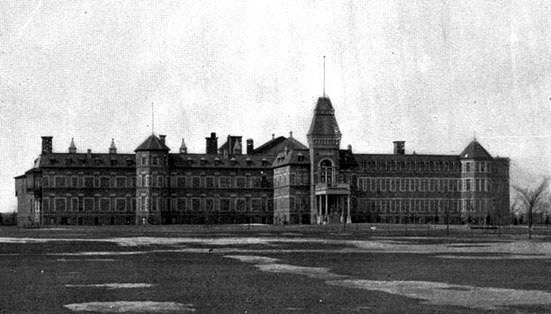
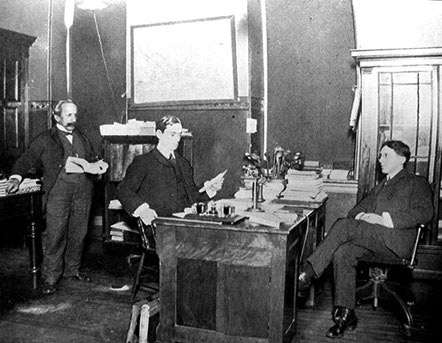
 Founded in 1881 by Alfred Perry and a group of Protestant clergy and Montréal citizens, the Douglas Hospital was named the “Protestant Hospital for the Insane” and was intended to be the most progressive mental health institution in Quebec.
Since its debut, the Hospital has had to continually depend on the community’s support to secure its development. Because it was not administered by a religious organization, as was the case for most French hospitals, it had to depend even more on public generosity and on volunteers. This culture of openness and partnership with the community has allowed us to successfully implement various community reintegration initiatives.
In 1946, the Hospital became affiliated with McGill University. Its training programs are recognized and continue to welcome increasing numbers of students in all disciplines related to mental health: psychiatry, nursing, psychology, occupational therapy etc.
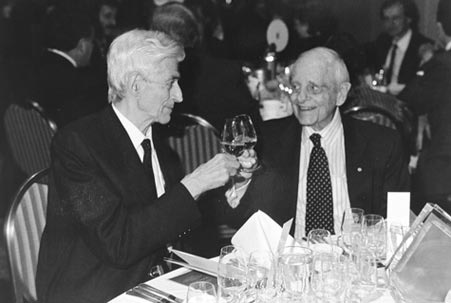
In the 1950s, a revolutionary breakthrough in mental health treatment and research was made by Douglas psychiatrist, Heinz Lehmann, MD, who introduced antipsychotic medications to North America. Thanks to these medications, many patients, until then considered incurable, were able to regain an active life in society. This development also gave rise to the creation of less restrictive approaches and triggered deinstitutionalization in the mid-1960s.
In 1965, the Hospital was named the Douglas Hospital in honour of James Douglas, MD, a major figure in psychiatry, and his family, who made generous donations to the Hospital during its fiscally-challenging early years.
In 1967, the Douglas Hospital became the first psychiatric institution in Canada to receive accreditation by the Canadian Council on Health Services Accreditation, in recognition of the quality of its services. During that period, the Hospital became increasingly committed to understanding the brain’s biological mechanisms, in order to explain the causes of major mental illnesses. A leader in the field of mental health research, the Douglas Hospital Research Centre was officially created in 1979 and now has an increasingly international reputation. It became a World Health Organization Collaborating Centre in 1982.
Today, the Douglas is a world-class mental health university institute that treats and offers hope and recovery to people who suffer from mental illnesses. Its teams of specialists, clinicians and researchers strive to constantly advance scientific knowledge, integrating it into patient care and sharing it with the community to raise awareness and reduce the stigma surrounding mental illness.
Timeline
| 2014 |
New Scientifi Director: Brigitte Kieffer, PhD New Douglas Institute Foundation CEO : Suzanne Bélanger |
| 2012 | New Executive CEO: Lynne McVey, N., M.Sc. |
| 2010 | Implementation of the Quebec Charter for a healthy and diverse body image. This action targets girls aged 14 to 17, who are most vulnerable to the negative effects brought on by images of extreme thinness. Creation of a professorship for the prevention of dementia and Alzheimer’s-related diseases. |
| 2009 | The At Home/Chez Soi project, which provides accommodation to homeless people struggling with mental health problems, is the largest initiative of its kind in the country. |
| 2008 | Inauguration of the Neurophenotyping Centre. The new research facility aims to study role of genes and environment in mental health. |
| 2007 | The Douglas' image is being updated with the launch of a new logo to denote its recent status as a Mental Health University Institute. The Douglas Institute is launching its first major awareness campaign, which will focus on anorexia and burn-out. |
| 2006 | The Douglas Hospital becomes a University Institute in Mental Health. The Douglas Hospital celebrates its 125th anniversary. Numerous activities are organized to raise public awareness of mental illnesses. The Hospital houses 233 inpatients. |
| 2005 | The Mood Disorders Program is created, including the Bipolar Disorders Program and the Depressive Disorders Program. |
| 2004 | The Centre for Studies on Human Stress is created within the Research Centre. The Research Centre expands with laboratories and other offices (20,000 sq. ft.) in Perry Pavilion. The Levinschi House opens its doors, thanks to the Gustav Levinschi Foundation. The Eating Disorders Program Day Hospital is created. The Research Centre celebrates its 25th anniversary with activities. The first Frames of Mind film series is held, offering movie nights with discussions on mental health issues. |
| 2003 | The Committee for a Substance Abuse Free Environment (C-SAFE) is formed to provide information, tools, and resources for Hospital patients who suffer from a combination of mental health and substance abuse problems. The McGill Group for Suicide Studies is established in the Research Centre. The Moe Levin Centre opens thanks to a generous donation by Mr. Moe Levin. It houses the Program for Dementia with Psychiatric Comorbidity. The Brain Imaging Group (BIG) opens its doors. The Prevention and Early Intervention for Psychoses Program, (PEPP-Montréal) is created. |
| 1999 | The Hospital adopts an organizational plan that introduces an organizational structure involving divisions and programs, shared governance, and the concepts of a learning organization and interdisciplinarity. A Clinical Activities Directorate is created to head the four new divisions. |
| 1997 | The Psychosocial Rehabilitation and Community Support Service (SPECTRUM) is created. The Hospital creates its first ACT (Assertive Community Treatment) Team. The Research Centre is awarded the Graham Boeckh Chair in Schizophrenia Studies. Guy Rouleau MD, PhD, is appointed director, based on his work on the genetics of schizophrenia. The chair also allows for the construction of a laboratory for the study of the genetic basis of mental disorders. The Hospital implements the 1997-2000 strategic plan and undertakes a major shift to out-patient care. It establishes nine sector teams and community support services to ensure follow-up of numerous patients who have reintegrated into the community. |
| 1996 | The McGill Centre for Studies in Aging moves to the Douglas Hospital campus. |
| 1995 | Rémi Quirion, PhD, is appointed the scientific director of the Research Centre. |
| 1994 | The catchment population served by the Hospital increases by 47 per cent following the closing of several hospitals in the Montréal region. Hospital Director General Jacques Hendlisz creates the Department of Psychiatry. |
| 1988-1989 | Crossroads and Le Tremplin day hospitals are created. |
| 1987 | Strategic plan objectives are presented, including a reduction of beds to 672 by 1992. |
| 1986 | The first ombudsman is hired. The Eating Disorders Program is created. A five-year financial campaign is launched to raise eight million dollars. |
| 1981-1982 | Recovery Plan by Ministry of Social Affairs: The Hospital must set aside $600,000 annually for alternative resources. |
| 1981 | The YMCA , located at 7105 LaSalle Blvd., is purchased and transformed into a day centre (L'Étape). The Montreal World Health Organization (WHO) Collaborating Centre for Research and Training in Mental Health opens its doors. |
| 1980 | The Research Centre, based on the technological and methodological infrastructure needs for research in psychiatry and mental health, creates three research divisions: neuroscience, psychosocial, and clinical. Researchers are grouped under four research themes: Aging and Alzheimer Disease; Mood, Anxiety and Impulsivity-Related Disorders; Schizophrenia and Neurodevelopmental Disorders; and Services, Policy and Population Health. Founded by Samarthji Lal, MD, Canada's first brain bank opens at the Research Centre. |
| 1979 | The Douglas Hospital Research Centre is established. N.P. Vasavan Nair, MD, is appointed its director. |
| 1972 | The Douglas Hospital Foundation is created. The first community mental health clinic opens its doors in LaSalle. People with mental illness are being hospitalized less and less. |
| 1967 | The Douglas Hospital becomes the first psychiatric hospital in Canada to receive accreditation by the Canadian Council of Hospital Accreditation. |
| 1966 | 1,840 inpatients are being treated. This represents the highest number of inpatients at the hospital at any time in its history. The Roberts Recreation Centre opens. |
| 1965 | The Hospital is named the "Douglas Hospital". |
| 1963-1965 | The Stearns, Finley, Lyall, Ward, Thomas, Wilson and Bond pavilions are built. |
| 1961 | The Frank B. Common Pavilion is built and the new Burgess Pavilion opens. |
| 1960 | Services for children and adolescents are created. Specific buildings are constructed for their needs. |
| 1958 | The Douglas Hospital Auxiliary is formed. |
| 1957-1965 | Medical Superintendent Charles A. Roberts, MD, together with Frank B. Common Jr., president of the Douglas Hospital Board of Governors, is responsible for rebuilding and modernizing the Hospital's inpatient units. |
| 1957 | Heinz Lehmann, MD, uses imipramine for the treatment of depression, a first for North America. |
| 1955 | The Beneficiaries' Committee is created. It is the first such committee in a Canadian psychiatric hospital. |
| 1953 | Expropriation of Hospital grounds north of the aqueduct. This area is now part of Angrignon Park. Heinz Lehmann, MD, becomes the first psychiatrist in North America to use chlorpromazine, the first antipsychotic. It is the start of a pharmacological revolution in psychiatry. Patient suffering is reduced and a number of psychotic patients return to community life. |
| 1946 | The Hospital becomes affiliated with McGill University, making it a teaching hospital for medical undergraduate, graduate, and postgraduate students. |
| 1939 | The Hospital houses over 1,200 inpatients. |
| 1938-1940 | New pavilions built: C.P.C. and Porteous |
| 1938 | The first tunnel is constructed. Today, our underground tunnel network extends 1.2 kilometres. |
| 1937 | The first director of nursing is appointed. |
| 1936 | The first female doctor is hired. |
| 1929 | Burgess Pavilion is transformed into a residence for private patients. |
| 1926 | The Occupational Therapy Department is created. |
| 1924 | The Hospital changes its name to the "Verdun Protestant Hospital". |
| 1920 | The first social worker is hired. |
| 1907 | A donation of $42,000 by James Douglas Jr., MD, makes it possible to buy a 60-acre farm to the east of the Hospital. |
| 1900 | McGill University medical students begin to receive lectures in psychiatry at the Hospital. The Hospital houses 354 inpatients. |
| 1897 | The Hospital's first nurse is placed in charge of the Hospital's infirmary (Burgess Pavilion). She cares for patients who are physically ill. |
| 1896 | The Hospital's first training school for nursing attendants is created. |
| 1894-1910 | Various pavilions are built: Lehmann Pavilion, Burgess Pavilion, Reed Pavilion, the McGill Centre for Studies in Aging, Newman Pavilion, and Douglas Hall. |
| 1890-1961 | The Hospital operates a farm until 1961. In the early years, it provides most of the food for patients and staff. |
| 1890 | Perry Pavilion is completed. Construction cost: $108,170. July 15: The Hospital's first patient is admitted. By the end of the year, 140 patients have been admitted. |
| 1889 | The first medical superintendent, Thomas J.W. Burgess, MD, joins the Hospital. He will direct the Hospital for 33 years. |
| 1888 | Construction begins on the Main Building, now Perry Pavilion. |
| 1887 | Headley Farm (110 acres) is purchased by the board of governors of the Protestant Hospital for the Insane. |
| 1885 | Protests are made by farmers owning land surrounding the proposed Hospital site, who fear that their livestock may catch mental illness from the patients. |
| 1881 | June 30: the Quebec Government passes the act titled “An Act to Incorporate the Protestant Hospital for the Insane” and the idea for the Hospital is born. |


